
Contemplation Through Our Shared Humanity
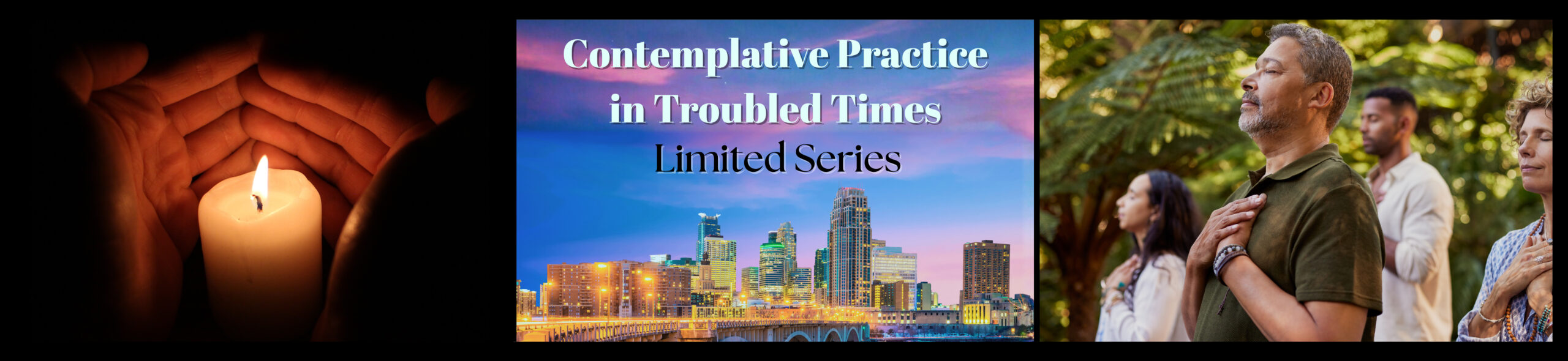
In these months of federal occupation in Minneapolis, as a person of faith and as a pastor, I have relearned that contemplation is connection – rather than, as I have sometimes been tempted in the past to believe, contemplation being withdrawal.
Partly because of the unpredictability of each day during this stretch, contemplation for me has taken a variety of forms even as it has continued to be vital every day. My usual contemplative practice of beginning the day with personal Scripture reading and prayer has grown to include other daily unplanned moments of encountering the divine. Each of these spontaneous invitations to contemplation has drawn me back into the “why” that any of this matters. In the midst of the very urgent “what” and “how”, contemplative moments – both intentional and surprising – have provided access to a deep well of compassion and energy that I cannot create or maintain on my own.
Why does it matter to resist this immoral and illegal government’s incursion into my community and into so many other beloved communities? Because all people are created in the image of God. Because Jesus made clear that the greatest commandment has two intertwined parts: to love God and to love neighbor. Because God chooses to most reliably be found on the margins, among those who are most vulnerable.
Contemplation is also keeping me connected to the “who” of my own humanity and the humanity of others, in these times when fear-mongering, suspicion, and hate are working hard to dehumanize us all. These daily moments of connection have reminded me that we all have bodies and bodily needs – among those needs: to rest, to eat, and to be present with others. I have found in those moments a spaciousness to check in with myself, sometimes finding that I am more angry than I realized … or more tired, or more hopeful, or more disconnected, or more energized. And they have kept me tuned in with the humanity of those I’m standing alongside and supporting – who are agents in their own right with their own gifts and needs, and not subjects of my good deeds. We’re all in this together; together we discover again the “why,” and together we embody it.
I am particularly grateful for the ways that the Singing Resistance has given words and voice to so many experiences and feelings in this time, drawing on the wisdom and rhythms of resistance movements from our own country as well as from around the world. These simple and profound songs have become life-giving and life-affirming mantras, not unlike the familiarity of liturgical scripture and hymnody in my Lutheran tradition that can adapt in seasons of the church year and seasons of life. I find myself regularly singing in response to spontaneous daily invitations to contemplation, sometimes alone and sometimes with others; sometimes in my head and sometimes aloud.
My congregation sang together, “Hold on/my dear ones/here comes to the dawn” on a Sunday morning when we’d read from Jesus’ Sermon on the Mount about being the salt of the earth, the light of the world, and a city on a hill that cannot be hidden. They were words that many of us had been singing and living in the streets of our city for weeks, and others were just learning. “I don’t know/if I can hold this alone/I need you/to sing this song” I hummed and prayed and cried one weekday afternoon, standing at the memorial for Alex Pretti and sharing sacred silence with dozens of strangers. As I scroll through social media or catch up on local, national, and international news, I often pause to remind myself that “Our joy is stronger than the fear./We see the path before us, and we are not afraid./We are a mighty chorus, and we are not afraid.”
Aided with words from Singing Resistance, unbidden contemplative moments have also challenged me to remember the humanity of those whose actions and words I oppose. “It’s okay to change your mind /show us your courage/leave this behind” I find myself singing in my car on my commute when I see a vehicle that looks suspiciously like ICE. Connecting through contemplation with the divine “why” and the human “who” has made the “what” and the “how” more manageable in the many weeks of constant crisis and now as individual and community harm continues through ongoing detentions; a housing-eviction crisis; and the trauma of children and adults alike trying to reclaim some sense of normalcy in these very abnormal times. I continue to hope, and trust, and pray, and sing: “We are here/with our neighbors/our love for each other/will carry us through.”
I hear your voice and sing your song with you. I feel your pain and see your tears. I know your presence and sense your hope. I pray with and for you.
My offering is presence with words that hold dialogue with the other as the means to the end that is sought for both the one and the other, a place that is without boundaries or limits, where the inexhaustible dwells, where hope becomes caring life itself.